
Why Antique temple Jewelry Is Trending in 2026 — And Ancient Indian Temples Are Behind this trend.
From Hampi's ruins to your jewellery box — the history you didn't know you were wearing.
you're not just following a trend. You're participating in a design legacy that's over a thousand years old. And it started not in a studio, but on a scaffold, with craftsmen carving stone temple walls by torchlight. Antique Indian jewellery and temple-inspired designs are everywhere right now. And look, it would be easy to write this off as another aesthetic cycle — the kind that peaks on Pinterest in October and disappears by January.... but that would be missing the point entirely. These pieces aren't trending because someone decided they should. They're trending because they never really stopped being relevant. We just forgot to pay attention for a while.It starts with ancient India's most ambitious building projects — its temples.
"Temples Weren't Just Places of Worship. They Were Cultural Powerhouses."
 Caption: Carved in stone. Worn in gold. India's most iconic jewellery designs have a history older than fashion itself. Pic credit: Pinterest.

Caption: Built in 1010 CE under Raja Raja Chola I — the Brihadeeswarar in Thanjavur is not just a monument, but a design manual jewellers have been reading for centuries.
Think of India's great ancient temples — the Brihadeeswarar in Thanjavur, the Meenakshi Amman in Madurai, the breathtaking ruins of Hampi — and you're looking at some of the most sophisticated artistic undertakings in human history. Not just Indian history. Human history. These weren't built in a year. They took decades, sometimes spanning multiple dynasties, each leaving its own creative imprint before passing the chisel to the next.The Brihadeeswarar Temple, built in 1010 CE under Raja Raja Chola I, started as a Chola masterpiece but carries the Marathas' fingerprints too. That kind of layering ,one dynasty picking up where another left off, adding, adapting, occasionally overcrowding is exactly what makes these structures so visually restless. And so endlessly quotable by jewelers, as it turns out.
Hampi is the other one. If you've been, you know. If you haven't — please go. Once the glittering capital of the Vijayanagara Empire and at its peak genuinely one of the wealthiest cities in the entire world, it's now a maze of corridors and ruins filled with motifs. So deliberate and detailed they make you want to sit down and just look for a while the theory of impermanence along with the richness of craftmanship which is little more constant which these architect.

Hampi image Caption: Walk through Hampi's corridors and you'll find motifs that feel oddly familiar — because they never really left. They just moved into your jewellery box. Picture Credit : ASI India website
Here's the thing the history books tend to skip to cover in detail — those motifs didn't stay on the walls. They walked out with the craftsmen and found their way, quietly and permanently, into the jewellery we're still wearing today.
Your Favourite Jewellery Designs? They're basically ancient architectures.
The artisans who carved temple walls and the ones who crafted jewellery were often trained in the same visual traditions, working from the same deep well of form and proportion. So when you pick up a jhumka and think — why does this feel so right? — part of the answer is that it was designed by people who spent their days inside some of the most beautiful spaces ever built. That gets into your hands eventually.
The Jhumka — Worn First in Stone

Caption: Before it was worn, it was carved. The jhumka's earliest appearances aren't in a jeweller's archive — they're on temple walls. Picture credit - Pinterest
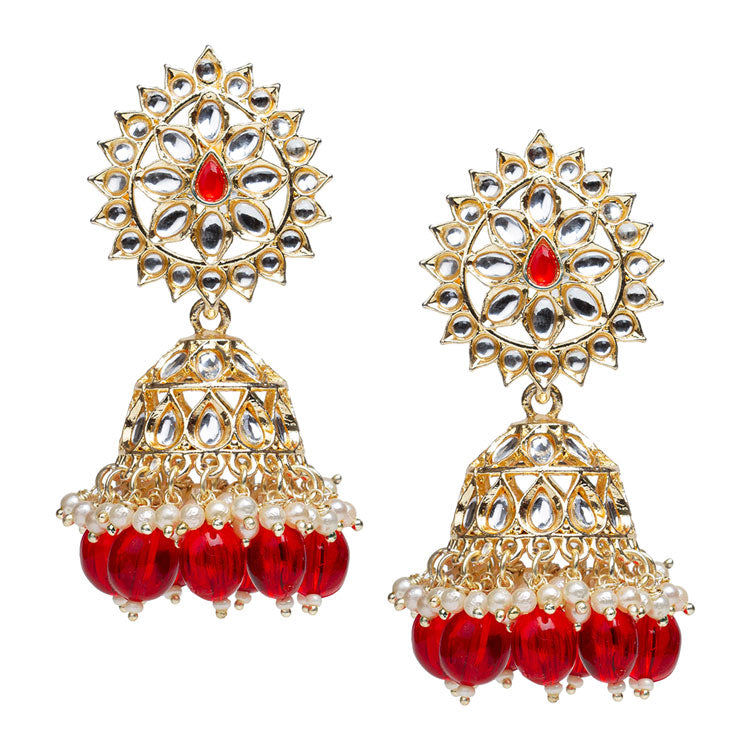
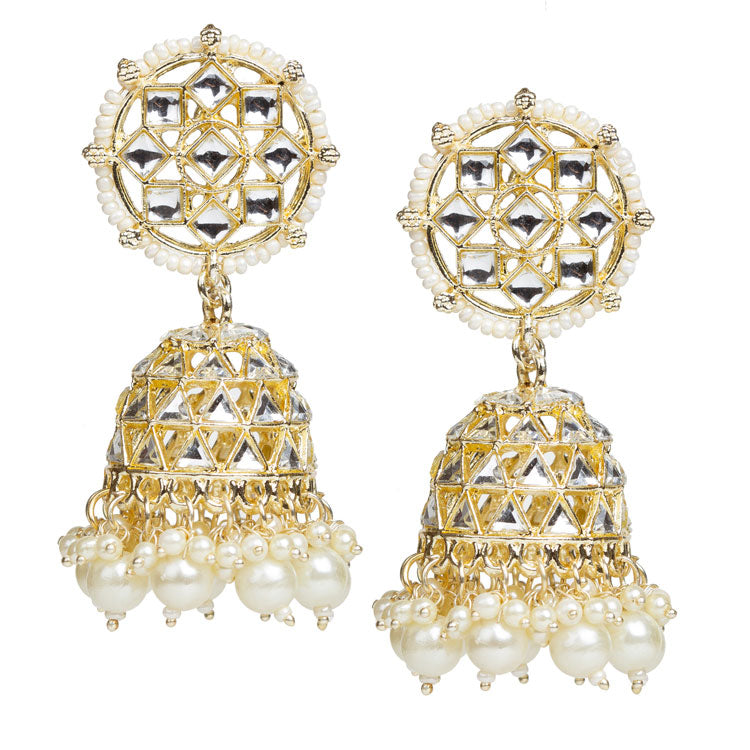
If you want to find the first jhumka, don't look in a jewellery box or some collection. Look at a Chola temple wall.The sculptures that adorn Chola temples — and there are thousands of them, goddesses and apsaras and celestial figures carved with a precision that still defies easy explanation — are wearing jhumkas. Fully formed, instantly recognizable, bell-shaped and layered, dangling from stone ears that have held the same pose for over a thousand years. The craftsmen who built these temples didn't just inspire the jhumka. They documented it. In permanent form, in permanent material, before a single one was ever cast in gold.What makes this remarkable is the direction of influence. It wasn't that jewellers designed a jhumka and sculptors copied it onto temple walls. It was the other way around — or at least, the two traditions were so deeply intertwined that separating them is almost beside the point. The same artistic vocabulary, the same sense of proportion, the same understanding of how an ornament should hang and move and catch the light — it lived simultaneously in the stone and in the metal.So when you wear a jhumka today, you're not wearing something inspired by a temple. You're wearing something that was born inside one.

Caption: Same silhouette, different material. What the sculptors carved in stone, the craftsmen recreated in metal in Bindhani temple style jhumka.
Filigree — The Jaali in Gold and Silver

Caption: The jaali screen — geometry so intricate it looks drawn, not carved.

Caption: Five hundred years of Cuttack's tarakashi tradition — the jaali, reborn in silver thread and recreated in materials like oxidised silver.
Filigree is essentially the jaali lattice screens of temple architecture, translated into twisted threads of gold and silver so fine they look like lace. Odisha's Cuttack filigree — practised for over 500 years — is the clearest surviving example of this lineage. Same geometry. Same obsessive patience. Just a different material and a completely different scale.
And there's something genuinely arresting about this. The fact that a stone pattern from a 12th century temple wall is still being recreated by hand in a workshop in Cuttack today. By families who've been doing it for generations, who probably don't think of it as preservation at all — it's just what they do. That's not a craft revival. That's continuity.
Temple Jewellery — Devotion You Can Wear

Caption: Temple jewellery was designed to command reverence. On a renowned Bharthanatyam legend like Alarmel Valli it still does — exactly as intended. Picture credit: Pinteterest
Temple jewellery designs — bold, unapologetic, built to be seen — directly mirror the ornamentation on sculpted idols. They were never designed for subtlety. They were designed for the same reason the temples themselves were built — to make you stop, look, and feel something larger than yourself. Whether that lands as spiritual or purely aesthetic probably depends on the day.
Every Dynasty Left Its Mark.
This part of Indian jewellery history doesn't get talked about enough, and it should — because it's what makes the whole thing so much richer than just "traditional Indian design."
As empires expanded and trade routes opened, royal courts became extraordinary melting pots. The Chola kings brought craftsmen from Gujarat. Persian and Greek aesthetics filtered in through conquest and commerce. The Mughals arrived with their obsession with symmetrical floral patterns — garden motifs, geometric precision, enamelwork so fine it looks painted — and Indian artisans absorbed all of it. Then made it so thoroughly their own you'd never trace the origin if you didn't already know where to look.

Mughal precision meets Indian craftsmanship — Kundan jewellery is centuries of cultural exchange, set in metal , kundan and stones....mostly preferred and adorned by Katthak dancers. Bindhani kundan necklace showcasing same craftsmanship and tarantism.
The Enduring Mango Motif
The mango, or kairi motif, is the best example of this kind of quiet assimilation. It crossed every regional line, showing up as elaborate Kundan and Jadau work in Rajasthan and as the beloved manga mala necklace in Tamil Nadu. Same idea, two completely different expressions. Both unmistakably Indian. Neither exclusively. This kind of design migration is genuinely fascinating — a single shape travelling across centuries and geography and arriving somewhere new every time.


Caption: One motif, a thousand years of travel. The mango is India's greatest design survivor. The North Indian Kairi Jhumkas and the traditional Mango necklace that is a part of the bridal trousseau in Kerala. picture credit : pinterest.
That's what gives heritage jewellery its particular depth. It's not one culture's story. It's many, folded into each other until the seams disappeared and what remained just felt like India.
So Why Now?
Honestly, a few things collided.
Temple tourism has had a quiet but real boom. People are going to Hampi, Thanjavur, Madurai — and coming home differently. There's something about standing inside a structure that's been standing for a thousand years that recalibrates you in a way a museum can't quite replicate. And then you want to carry a piece of it. Not a fridge magnet. Something you'll actually wear.
At the same time there's been this broader, unmistakable shift — away from fast fashion, toward things that mean something. Pieces you didn't just buy — pieces you chose. Antique-inspired jewellery sits exactly in that space. It's investment dressing in the truest sense. It holds its weight in a silk saree, a linen co-ord, or a blazer you've worn three ways this week.

Caption: Old soul, modern muse. Antique jewellery isn’t just about dressing up—it’s about dressing with intention. Sobhita Dhulipala beautifully channelled her Telugu roots through timeless temple jewellery during her wedding celebrations. Picture credit : Pinterest
And it photographs beautifully. Which in 2026 is never not a factor, let's be honest.
How to Actually Wear It :-
The idea that temple jewellery is only for weddings is well and truly over. Here's how it's actually being worn:
- Jhumkas with everything — oversized ones with a white kurta, smaller ones slipped under a blazer. There is genuinely no wrong answer here.
- Filigree pieces as the centrepiece of a minimal outfit — the craftsmanship is doing the heavy lifting, just let it.
- Temple chokers layered with longer chains — mixed metals, mixed eras, somehow completely current.
- Temple sets styled down — just the earrings with straight-leg jeans, or just the nath with a contemporary drape. You don't have to wear it all at once and honestly you probably shouldn't.
The combination that always works? Ancient and modern in the same look. The contrast does something that's hard to explain but immediately visible. It always has.
The Takeaway:-
The reason antique jewellery keeps coming back isn't nostalgia. These designs were never really about a moment — they were built on something far more permanent. Architecture. Devotion. Centuries of craft passed down through families who understood that the difference between good work and great work is often the part no one else would notice but you.
When you wear a jhumka or a piece of filigree, you're wearing a design philosophy that survived empires, outlasted trends, and still manages to feel completely, quietly relevant.
That's not a comeback. That was always the plan.
And at Bindhani, it still is.

Caption: Asthetic beauty in South style temple jhumki pic credit: Pin interest.
pieces in our collection carries this forward — not as a tribute to the past, but as a continuation of it. Craft that was built to last, designed for the way you actually live. The temples are still standing. The tradition is still alive.
Come find your piece of it.
Quick Answers from this blog:
What is temple jewellery? Traditional Indian jewellery originally made to adorn temple deities, originating in South India during the Chola dynasty. Known for bold, gold-heavy designs featuring sacred motifs — and increasingly, for looking incredible with contemporary outfits.
Where does the jhumka come from? The jhumka's bell-shaped silhouette is directly inspired by the bronze bells inside Indian temples. The design appears in temple sculptures dating back over 500 years. It has never really gone out of style — because it was never really in style to begin with. It just always was.
What is filigree jewellery? An ancient technique of twisting fine gold or silver threads into intricate lace-like patterns. India's most celebrated filigree tradition comes from Cuttack, Odisha — over 500 years of unbroken craft history in one city.
Why is antique jewellery having a moment? Temple tourism, social media, and a cultural shift toward meaningful pieces over fast fashion all converged at once. People want jewellery with a story. Indian heritage jewellery has one of the best stories going — it just took a while for the rest of the world to catch up.
How do I style antique jewellery for everyday wear? Contrast is everything. One bold heritage piece against a simple modern outfit. Let the craftsmanship do the work — your job is just to get out of its way.
Written by _ Arishwarya Mohan
Eidted by_Hansa Rajpurohit