
Worn on the Forehead. Written in the Stars.
From the maang tikka to the Rajasthani borla — why every Indian forehead ornament was placed exactly where it was.

Caption: A bride adorned in the solah shringar — every ornament placed with purpose, every piece carrying meaning older than the wedding itself. Alia Bhatt as a modern Indian Bride from the movie Rocky aur Rani ki Prem Kahani.
We've been taught to think of jewellery as decoration. Something you add at the end, after the outfit is sorted, after the hair is done. An afterthought dressed up as an accessory.
But Indian bridal forehead jewellery — the maang tikka, the mathapatti, the borla, the netti chutti — was never designed that way. Not even close.
Long before these pieces became wedding photographer staples, they existed for reasons that had nothing to do with aesthetics. Every ornament is placed on a specific part of the body, at a specific pressure point, with a specific intention. The women who wore them may not have called it science. But that's exactly what it was.
The Body as a Map :-
Ancient Indian thought — across Ayurveda, yoga, and tantric traditions — understood the human body as an energy system. A network of nadis, or energy channels, converges at specific points called marma points or chakras. These points, when activated, influenced everything from physical health to emotional clarity.
Jewellery was one of the tools used to activate them.
The metals, the stones, the placement — none of it is arbitrary. Gold was believed to conduct positive energy. Silver was cooling, grounding, and associated with the moon. Specific gemstones are prescribed almost like medicine — ruby for vitality, pearl for calm. And the location of each ornament on the body corresponded directly to an energy center it was meant to stimulate or protect.
This is why a woman adorned in the solah shringar — the sixteen traditional bridal adornments — wasn't just dressed beautifully. She was, in the understanding of the time, fully activated.

Caption: Sixteen adornments. Sixteen intentions. Never just a checklist.
Picture credit: Aishwarya Rai as Queen Jodha Bhai from the movie Jodha Akbar.
The Forehead — Where It Gets Interesting
In yogic tradition, the space between the eyebrows — the ajna chakra, the third eye — is the seat of intuition, perception, and inner wisdom. Where thought becomes clarity.
It is not a coincidence that this is exactly where Indian jewellery places its most deliberate, most elaborate ornaments. The forehead was always sacred geography — marked with kumkum, adorned with a bindi. The jewellery that sits here is the extension of that same reverence. More permanent. More deliberate. More alive.
What follows are four forehead ornaments — each from a different region, each with its own logic, each far more considered than most people realize.
The Maang Tikka — Activating the Third Eye

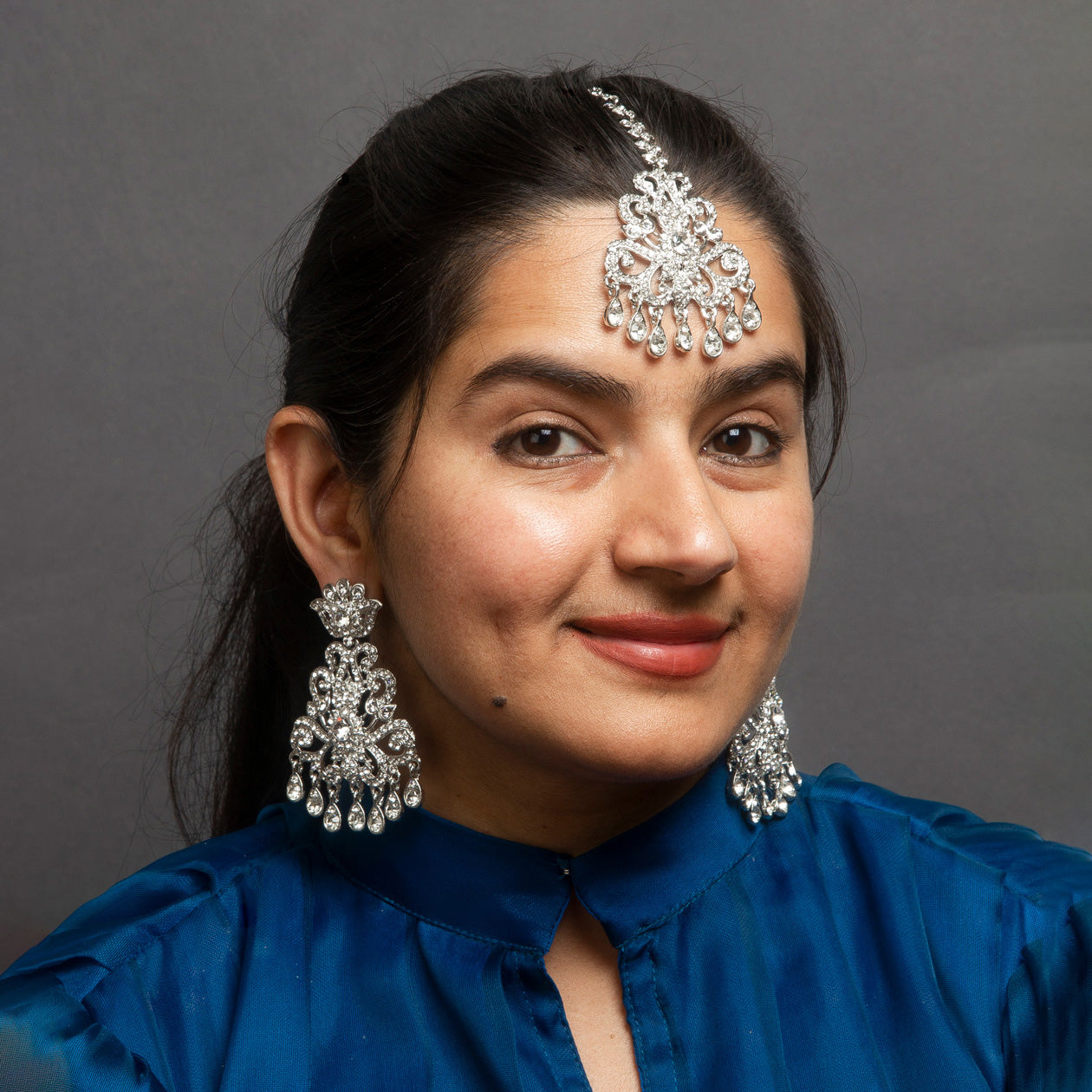
Caption: The maang tikka doesn't sit between the brows by accident. It never did.
Ask most people why a bride wears a maang tikka, and they'll say tradition. Ask why it sits exactly where it does, and you'll get a shrug???
Here's the answer. The ajna chakra sits precisely at the mid-forehead, just above the point between the brows. In Ayurvedic tradition, this is also a significant marma point — one that, when stimulated, is believed to calm the nervous system and promote mental stillness. The gentle weight of the maang tikka, its cool metal resting against this point throughout a ceremony that can last hours, was understood to activate and balance this energy centre.
For a bride stepping into the most significant transition of her life, this wasn't decoration. It was preparation.


Caption: One piece, a thousand expressions. Always in the same place.
And for what it's worth, modern neuroscience has independently arrived at its own version of this. The prefrontal cortex, sitting directly behind the mid-forehead, governs decision-making and emotional regulation. The stimulation of pressure points in this region has been studied for its effects on stress response and cognitive clarity.
Nobody is saying the maang tikka is medicine. But nobody who designed it was being arbitrary either.
The Mathapatti — Crowning the Crown

Caption: The mathapatti doesn't just crown the head — it honours what lives inside it. Picture credit: Pinterest
The Mathapatti is the most architecturally ambitious of all forehead ornaments. A full headpiece fanning across the crown of the head, draping toward the temples and forehead, and sitting directly over the sahasrara chakra. The crown chakra. The seat of consciousness itself in yogic tradition.
A crown in the most ancient meaning of the word. Not a symbol of status — an acknowledgment of what it covers.
The best mathapattis — the ones passed down through families, reappearing at weddings generation after generation — are extraordinary feats of goldsmithing. They move with the wearer. Catch light differently at every angle. Designed for someone in motion — dancing, bowing, turning. They were designed for life. And they perform accordingly, every single time.
The Borla — Rajasthan's Sacred Threshold Marker

Caption: The Borla doesn't sit lightly. It was never meant to. It was always meant to make a statement.
If you've been to a Rajasthani wedding, you know the borla immediately. That large, spherical gold pendant is sitting with absolute authority at the centre of the forehead. It doesn't whisper the way a maang tikka does. It announces.
The borla sits at the brahmarandhra — the point at the top of the forehead considered in yogic tradition to be the gateway between the physical and the spiritual. The point where the soul is believed to leave the body at death. And the point where, at the moment of marriage, a woman is understood to be crossing a threshold of equal significance.
Wearing the Borla here was a deliberate act of marking. This moment matters. This transition is real. This woman is seen.
In Rajasthan, the borla also carried community identity — its design, size, and craftsmanship indicating the bride's family, her standing, and her region. In Marwari families, it was — and in many still is — non-negotiable. Not stylistic. Essential.
What I find quietly remarkable about the Borla is how honest it is about what it's doing. Most jewellery encodes its meaning. The Borla just states it. Here is the threshold. Here is the woman crossing it. Bear witness.
The Netti Chutti — South India's Most Underappreciated Bridal Ornament

Caption: Popular South Indian Actress Keerthi Suresh adorning the traditional Netti chutti during her wedding Muhurtham. Netti chitti - The jewellery was made for temple walls.
Honestly, the netti chutti deserves far more attention than it gets outside South India.
A central pendant at the hairline, chains fanning outward across the full forehead, it treats the entire forehead as its canvas rather than a single central point. Netti means forehead in Malayalam. The ornament takes that literally.
Its roots go directly back to the Chola period — temple sculptures of celestial figures and goddesses adorned with exactly this kind of full-forehead ornamentation. The craftsmen who carved those figures and the ones who made this jewellery weren't just drawing from the same tradition. In many cases, they were the same people. The netti chutti didn't draw inspiration from temple art. It came out of it.
Where the maang tikka is targeted, and the borla is declarative, the netti chutti is enveloping. It says all of this matters. Every part of this space is worth honouring.
Worn with a Kerala mundum neriyathum or a Kanjivaram silk, it doesn't complete a look. It defines one.
Why Any of This Still Matters
We are not sure exactly when we stopped understanding this. Somewhere between then and now, jewellery became just jewellery. Something you match to your outfit rather than something you place on your body with any awareness of what that placement means.
But there's something that shifts when you put on a maang tikka, knowing what it's resting on. When you wear a borla understanding what threshold it was designed to mark. It becomes less automatic. More considered. Something closer to a ritual than a routine.
That shift — from accessory to intention — is what Indian jewellery has always been asking us to make.
We're just finally beginning to listen.

Caption: You don't need the full solah shringar to wear the intention. Sometimes one piece is enough. Picture credit: Pinterest
At Bindhani, Intention Is Where We Start.....
There's a particular kind of woman who finds Bindhani. She's not just looking for something beautiful — though beautiful matters to her enormously. She's looking for something that means something. A piece she can wear knowing it carries more than just craft.
The forehead ornaments in our collection — maang tikkas, mathapattis, borlas, netti chuttis — aren't designed as costume pieces or bridal additions that live in a box for eleven months of the year. They're for the woman who understands that what she places on her body is a choice. And that some choices carry more weight than others.
We don't think that's a niche point of view, honestly. We think most women feel this — they just haven't always had the language for it. Maybe this helps.
Come find your piece of it.
The Takeaway
Indian jewellery was never just about looking beautiful. It was about feeling whole. About acknowledging that the body is more than a surface — it's a system. And that the women who came before us understood something about adornment that we're only just beginning to rediscover.
The maang tikka that steadies the mind. The mathapatti that crowns consciousness. The borla that marks the threshold. The netti chutti that honours every part of the space.
Wear them knowing what they are. That changes everything.
Explore Bindhani's forehead ornament collection — rooted in centuries of intention, made for the way you live and celebrate today....teaming with earring , necklaces or both .
Quick Answers
What is the significance of Indian bridal forehead jewellery? Indian bridal forehead jewellery was never purely decorative. Each piece — the maang tikka, mathapatti, borla, netti chutti — sits at a specific energy point on the body, placed with intention rooted in Ayurvedic and yogic tradition. The forehead in particular has always been considered sacred geography in Indian culture, making these ornaments some of the most energetically significant pieces in the entire bridal tradition.
What does the maang tikka symbolise? The maang tikka sits at the ajna chakra — the third eye — considered the seat of intuition and mental clarity. Its placement was understood to calm the nervous system and ground the wearer. For a bride, it was preparation as much as adornment. Modern neuroscience independently supports the significance of this region of the forehead in governing emotional regulation and decision-making.
What is the significance of the Rajasthani borla? The borla sits at the brahmarandhra — considered the gateway between the physical and spiritual in yogic tradition. It marks a bride's crossing into a new life and has carried deep community identity in Rajasthan for centuries. In Marwari families, it remains non-negotiable — not a stylistic choice but an essential part of the bridal trousseau.
What is the difference between a maang tikka and a mathapatti? The maang tikka is a single pendant sitting at the mid-forehead, targeted and precise in its placement at the ajna chakra. The mathapatti is a full headpiece covering the crown of the head, sitting over the sahasrara or crown chakra. One steadies the mind. The other acknowledges consciousness itself.
What is a netti chutti? A South Indian forehead ornament rooted in Chola-era temple sculpture, worn primarily in Kerala and Tamil Nadu. It covers the full forehead with chains fanning outward from a central pendant — one of the most underappreciated and culturally specific bridal ornaments in India.
What is the solah shringar? The sixteen adornments traditionally considered complete for an Indian bride — each corresponding to a specific part of the body and energy centre. One of the oldest and most complete systems of intentional adornment in the world.
Can forehead ornaments be worn outside weddings? Yes — and increasingly they are. A delicate maang tikka with a contemporary outfit is one of the most elegant styling choices in Indian fashion right now. Wear it knowing what it means and let it be the focal point. That's genuinely all it needs.
Written by _ Aishwarya Mohan